The short answer
A home with hard well water and iron usually needs an iron filter first and a softener second. The simplest way to buy that is the Mid Atlantic Water package at $3,995: a Fleck iron filter (up to 30 ppm iron) followed by a 48,000-grain softener, sized for 2-4 people and up to 10 GPM. On city water with hardness and a chlorine taste, pair a carbon filter with a softener; on city water with scale but no need to soften, see the salt-free option.
We earn a commission when you buy through some links on this site, at no extra cost to you. It never changes what we recommend.
- Water inCity main or well pressure tank.
- Sediment filterCatches sand and particles first, so later stages don't clog.
- CarbonReduces chlorine, taste and odor.
- SoftenerRemoves hardness (only if you need it).
- UV (wells)Disinfects last: it needs clear, low-iron, low-hardness water to work.
Order follows the multi-stage example in Nebraska Extension G1714. Your equipment manuals and local plumbing code have the final say, and UV makers set their own pre-treatment limits.
Our picks
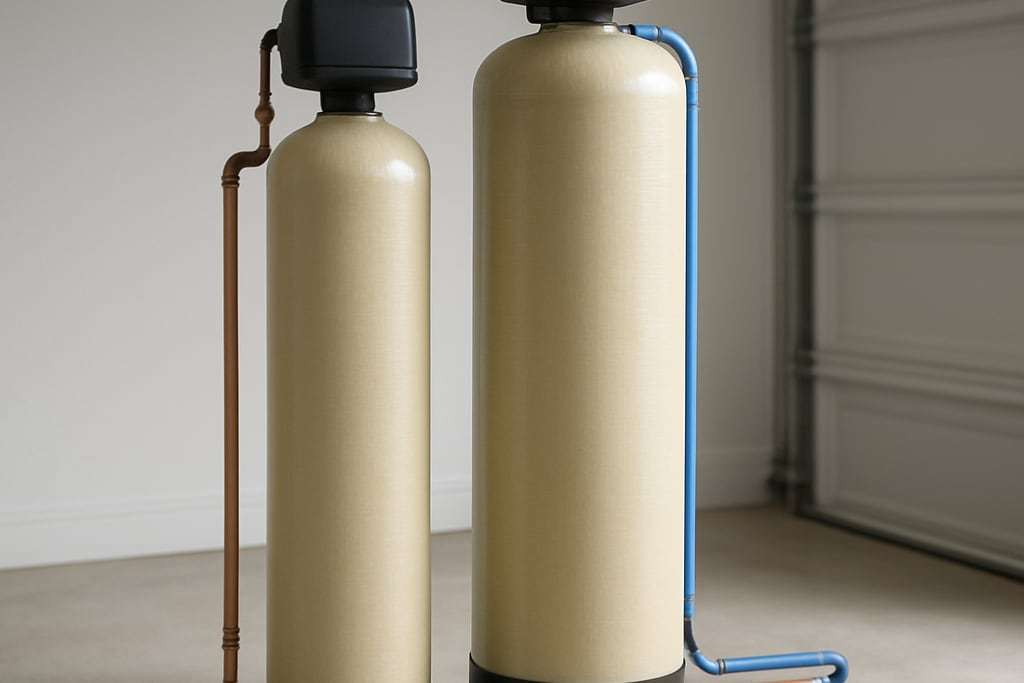
Fleck 2510 iron filter (1.5 cu ft Katalox Light) + Fleck 5600SXT 48,000-grain softener package
Iron filter and salt-based softener package
Katalox iron filter (up to 30 ppm iron) first, then a 48,000-grain softener, for 2-4 people and up to 10 GPM. $3,995.
- Media lifeKatalox Light about 6 to 8 years before the tank is re-bedded
- CertificationNSF/ANSI 61 certified components
- Sized for2 to 4 people, up to 3 bathrooms, up to 10 GPM whole-house flow
Listed price$3,995
Check price at Mid Atlantic Water (Fleck valves)Specs & trade-offs
- Iron filter
- Fleck 2510 AiQ air-injection valve; 1.5 cu ft Katalox Light; 10 in x 54 in tank; 10 GPM service, 5 GPM backwash
- Rated removal (iron filter)
- Iron up to 30 ppm; manganese up to 15 ppm; hydrogen sulfide up to 10 ppm
- Softener
- Fleck 5600SXT; 48,000 grains; 1.5 cu ft of 10% crosslink resin; 10 in x 54 in tank; up to 12 GPM service
- Sized for
- 2 to 4 people, up to 3 bathrooms, up to 10 GPM whole-house flow
- Media life
- Katalox Light about 6 to 8 years before the tank is re-bedded
- Warranty
- 5 years on each Fleck valve; 10 years on each mineral tank
- Certification
- NSF/ANSI 61 certified components
- pH note
- Iron removal works best near pH 8; a lower-pH well may need an acid neutralizer added
- Iron filter and softener sold as one correctly ordered system (iron filter first, softener second), with a published 30 ppm iron rating
- No salt, chemicals or cartridges on the iron filter side; free shipping and a free phone consultation on sizing
- Costs about $2,000 more than the softener alone
- Two systems to install: two outlets, two drains, and a plumber is recommended
- The ratings are the seller's own; only the components carry a certification (NSF/ANSI 61, which covers materials)
SoftPro AIO Iron Master (air-injection iron filter, Katalox media)
Air-injection iron filter
Rated for iron up to 30 ppm, from $1,517, installed ahead of the softener so iron does not reach the resin.
- Sizes and minimum well flow1.0 cu ft needs at least 5 GPM; 1.5 cu ft at least 7 GPM; 2.0 cu ft at least 10 GPM (for backwash)
- Media and methodKatalox Light with air-injection oxidation; no chemicals, salt or permanganate
- Rated removalIron up to 30 ppm (larger units or a dual setup may be needed at the high end); manganese up to 7 ppm; hydrogen sulfide
Listed price$1,517 (1.0 cu ft); $1,757 (1.5 cu ft); $1,897 (2.0 cu ft)
Check price at SoftProSpecs & trade-offs
- Rated removal
- Iron up to 30 ppm (larger units or a dual setup may be needed at the high end); manganese up to 7 ppm; hydrogen sulfide
- Sizes and minimum well flow
- 1.0 cu ft needs at least 5 GPM; 1.5 cu ft at least 7 GPM; 2.0 cu ft at least 10 GPM (for backwash)
- Media and method
- Katalox Light with air-injection oxidation; no chemicals, salt or permanganate
- Other
- Raises low pH; filters sediment down to 3 microns; 1 in programmable valve with automatic backwash
- Placement
- Installs ahead of the softener so iron does not reach the resin
- Higher published iron rating (30 ppm) than SpringWell's WS filter (7 ppm), and a lower entry price ($1,517 vs starting at $2,100)
- No chemicals to refill
- Needs enough well flow to backwash (5, 7 or 10 GPM depending on size)
- The 30 ppm figure is SoftPro's own rating; no independent certification is shown
- Does not soften, so hard water still needs a softener after it
Bodyguard Whole House Filtration + Green Wave Salt-Free Softener Alternative (SKU 198-WHFSF-100)
Whole-house filter with salt-free conditioner
Five stages including carbon and a salt-free conditioner in one system at 10, 15 or 20 GPM.
- Flow rate10 / 15 / 20 GPM service; peak 25 GPM listed
- StagesKDF-55, GAC, catalytic carbon, Interceptor filter, then Green Wave salt-free NAC/CTAC conditioner
- CertificationKDF-55 listed as NSF-certified; carbon stages listed as WQA-certified
Listed price$2,359 (10 GPM); $2,999 (15 GPM); $3,531 (20 GPM)
Check price at US Water SystemsSpecs & trade-offs
From $2,359. It does not remove hardness.
- Flow rate
- 10 / 15 / 20 GPM service; peak 25 GPM listed
- Stages
- KDF-55, GAC, catalytic carbon, Interceptor filter, then Green Wave salt-free NAC/CTAC conditioner
- Certification
- KDF-55 listed as NSF-certified; carbon stages listed as WQA-certified
- Backwash
- None on the conditioner
- Warranty
- 10-year warranty plus 1-year satisfaction guarantee (money back)
- No salt and no drain: the conditioner has no backwash
- Carbon stages (GAC and catalytic carbon) and an Interceptor filter come before the conditioner
- Green Wave conditions minerals rather than removing them, so spots on glassware may still appear
- Does not remove fluoride
- Certifications are named for individual stages, not for the complete system
| Model | Best for | Type | Listed price |
|---|---|---|---|
| Fleck 2510 iron filter (1.5 cu ft Katalox Light) + Fleck 5600SXT 48,000-grain softener package | Best iron filter plus softener for a well | Iron filter and salt-based softener package | $3,995 |
| SoftPro AIO Iron Master (air-injection iron filter, Katalox media) | Best iron filter to put ahead of a softener | Air-injection iron filter | $1,517 (1.0 cu ft); $1,757 (1.5 cu ft); $1,897 (2.0 cu ft) |
| Bodyguard Whole House Filtration + Green Wave Salt-Free Softener Alternative (SKU 198-WHFSF-100) | Best filter plus salt-free conditioner for city water | Whole-house filter with salt-free conditioner | $2,359 (10 GPM); $2,999 (15 GPM); $3,531 (20 GPM) |
A whole house water filter and a water softener solve different problems. A softener removes the calcium and magnesium that make water hard. A filter removes what it is built for, usually sediment and carbon-adsorbed chemicals such as chlorine and taste compounds, or iron on a well. A home with both kinds of problem usually needs both, installed in the right order. This guide explains how to tell, what goes first and what the pair costs. For a choice between the two, see the softener versus filter comparison.
Start with the problems you actually have
Hardness. Hardness is mostly dissolved calcium and magnesium, reported as calcium carbonate (University of Nebraska Extension). NDSU Extension says consumers typically notice problems such as scale and soap scum above about 6 to 7 grains per gallon. To turn a lab number in ppm into grains, use the hardness converter.
Chlorine, taste and sediment. Activated carbon removes residual chlorine, taste and odor, and many organic compounds. It does not remove hardness, nitrate, fluoride or most metals. A sediment cartridge, usually 5 micron, catches particles and protects the carbon behind it. University of Georgia and Penn State both recommend a sediment filter at the point of entry.
Iron. Clear, dissolved iron turns reddish-brown when it meets air. Once iron has oxidized, ion exchange cannot remove it, so it needs filtration. Softeners handle dissolved iron only up to a limit, and the extension sources give different numbers, so use the limit the unit’s maker rates. Above that, use an iron filter first; see our guide to the best iron filter for well water.
When you need both
- Hard city water with a chlorine taste or sediment. The filter handles taste and particles, and the softener handles scale. Our whole-house filter guide covers the filter side.
- Hard well water with sediment and a little dissolved iron. A sediment stage plus a softener rated for the iron level can cover it, if the test supports that. The well water softener guide names the softeners that publish an iron limit.
- Well water with red iron, manganese or sulfur. You need an oxidizing or iron filter before the softener. A softener alone is not enough, and the sulfur smell guide covers the options by level.
You probably need only one part if your only problem is hardness (a softener), or only taste and chlorine (a filter). If the water may carry bacteria, neither part is the answer on its own. Test first; the well water testing guide explains what to ask a lab for.
Install order: filter first, then softener
For city water with sediment or chlorine taste, the order is simple: filter first, then soften. Penn State warns that oxidized iron clogs resin, and turbid water can do the same, so the softener should not be the first thing the water meets.
For iron-heavy well water, Nebraska Extension’s multi-stage example chlorinates first to oxidize iron and kill iron bacteria, then filters the particles, then uses carbon to strip the excess chlorine, then softens. That is a designed system, and it is not the same case as clear, dissolved iron. The Mid Atlantic Water package states the order outright: iron filter first, softener second.
Two cautions. First, if your iron is clear and dissolved and you plan to let the softener handle it, Nebraska says the water must not touch air or chlorine before the softener. That can rule out some stages, so ask the installer to design the order around your test results. Second, many homes leave the kitchen cold tap unsoftened, because softening adds sodium. NDSU Extension notes that roughly 8 mg/L of sodium is added for each grain per gallon of hardness removed, so a kitchen tap that stays unsoftened avoids that sodium for drinking and cooking.
Ask for bypass valves on both parts, so one can be taken out of line for service while the other keeps running. Local code and a licensed plumber decide the connection points, pressure relief and any backflow requirements.
What the combo costs
Prices change often, so use these as ranges and check the seller for today’s figure.
| Item | Range | Source |
|---|---|---|
| Softener hardware | About $500 to $1,500 | Penn State Extension |
| Salt-based softener, installed | About $500 to $3,000 total | Bob Vila |
| Installation labor for a softener | $150 to $1,000, most jobs $500 to $700 | This Old House |
| Carbon whole-house filter | About $450 to $600 up to $1,000 to $2,000 | Brand and reseller listings |
| Iron filter plus 48,000-grain softener package | $3,995 | Mid Atlantic Water |
| SoftPro Iron Master alone | $1,517 to $1,897 by size | SoftPro |
| Salt | $5 to $10 per 40-pound bag of sodium chloride | NDSU Extension |
| Softener resin service | About $100 to $200 a year for tank cleaning | This Old House |
| Filter cartridges | About $40 to $120 each, changed every 6 to 12 months | Contractor price estimate |
Add the filter price, the softener price, installation for both, and the yearly salt and cartridge costs. The water softener cost guide and the whole house filter cost guide show the running figures in more detail. The comparison page has every model in one table.
How to choose a combo
Test first. Get hardness in grains per gallon, dissolved and total iron, manganese, pH, sulfur, and bacteria if you use a well. Ask the utility whether it uses chlorine or chloramine; the annual water quality report says which.
Match the flow rate. Each brand lists a service flow (the steady rate) and sometimes a higher peak. Compare the number you need with the one the brand quotes, and say which one you used. The flow rate calculator gives a starting figure. The Mid Atlantic package is sized for up to 10 GPM and three bathrooms. The SoftPro Iron Master needs 5, 7 or 10 GPM of well flow to backwash, depending on size.
Size the softener by grains and salt. A softener’s grain capacity depends on the salt setting. The Fleck 48,000-grain softener lists about 45,000 grains at 15 lb of salt and about 36,000 at 9 lb. The softener size calculator shows how to work out the grains you need.
Look for the right certification. Only NSF/ANSI 44 covers a softener’s hardness removal and efficiency. For filter claims, NSF/ANSI 42 covers aesthetic effects such as chlorine taste, and NSF/ANSI 53 covers health-related reductions. Check the model number in the NSF or WQA listing. The Mid Atlantic package carries NSF/ANSI 61 on its components, which covers materials, not performance. A statement that parts are tested, or that a tank is certified, does not certify the whole system for a claim.
Read the warranty. The Mid Atlantic package has 5 years on each Fleck valve and 10 years on each mineral tank. US Water Systems lists a 10-year warranty plus a one-year satisfaction guarantee on the Bodyguard.
Parts to pair
The Mid Atlantic package is the one finished combo for a well. It costs about $2,000 more than the softener alone, needs two outlets and two drains, and the ratings are the seller’s own. Its iron filter works best near pH 8, so a lower-pH well may need an acid neutralizer added, and it is not suited to wells with bacteria unless UV is added downstream. The SoftPro Iron Master is the pick if you already have a softener, or want to choose one separately. The US Water Systems Bodyguard is the one-box option for city water, but its Green Wave stage is a salt-free conditioner, so it prevents scale without softening.
Who should skip a combo
- Homes with one problem. Hardness only is a softener job; taste or sediment only is a filter job. Paying for both adds cost and salt use without fixing anything new.
- Water with bacteria and no treatment plan. A carbon filter and a softener do not make microbiologically unsafe water safe. Get the water tested and talk to a water treatment professional before you buy.
- Households that must limit sodium. Softened water adds sodium. If you have a medical reason to limit sodium or potassium, ask your doctor before choosing a softener.
- Homes on septic systems. Each softener regeneration uses about 50 gallons of water, and Penn State Extension warns that this can load a septic system. Check the regeneration setting with an installer.
- Water with iron above the softener’s rated limit. Buying a bigger softener does not raise that limit. Add an iron filter first.
Buying mistakes to avoid
- Buying by grain count alone. A large grain number at a high salt setting is not the same as the rated capacity you will use every day. Check flow and salt setting too.
- Expecting a filter to soften. Carbon does not remove hardness, so spots and scale will remain.
- Skipping the water test. Hardness, iron and bacteria each change the answer.
- Reading “lifetime” as “everything”. Warranties come with water and maintenance conditions.
- Treating a “list” price as a discount. Compare the price you are actually quoted, on the same date.
- Forgetting media replacement. Iron filter media lasts years (Katalox Light about 6 to 8 years in the Mid Atlantic filter) but not forever. Plan that cost before you buy.
Frequently asked questions
Do I need a water softener and a whole house filter?
Only if you have both problems. A softener removes calcium and magnesium, the minerals behind hard water. A carbon filter handles chlorine, taste, odor and some organic compounds, but it does not remove hardness, so a filter alone will not stop scale or spots. Test your water first and let the results decide.
Which should go first, the filter or the softener?
Filter first. Sediment and oxidized iron can clog softener resin, so particles come out before the softener. Nebraska Extension's multi-stage example for iron-heavy well water chlorinates first, then filters the particles, then uses carbon to strip the excess chlorine, then softens. Your equipment maker's manual sets the exact order, and local code and a licensed plumber decide the install.
Can one unit do both jobs?
Not one set of media. A filter and a softener are two tanks with different jobs, even when one seller packages them together. The Mid Atlantic Water package is two systems that need two outlets and two drains, and the seller recommends a plumber. Read the listing for what is in the box, the flow rating of each part, and whether the price includes a bypass valve and installation.
Does a whole house filter make well water safe to drink?
Not by itself. Carbon does not remove bacteria, and the University of Georgia bulletin says carbon should be used only on water that is already microbiologically safe, because carbon can grow bacteria. For a private well, get a lab test first and treat bacteria with a method that fits the results, such as UV after pretreatment.
What does the whole setup cost?
Add the parts. The Mid Atlantic Water iron filter and softener package is $3,995 before installation. Salt-based softeners run from about $500 to $3,000 installed depending on the source, and carbon whole-house filters from about $450 to $2,000. Budget for salt, resin service and cartridge changes on top of the purchase price.
Sources
- University of Nebraska Extension: NebGuide G1274
- Penn State Extension: Water softening
- University of Georgia Extension: Bulletin B1542
- University of Nebraska Extension: NebGuide G1714 (iron, manganese and sulfide)
- Mid Atlantic Water: Fleck iron filter and softener package
- SoftPro: AIO Iron Master iron filter
- US Water Systems: Bodyguard with Green Wave salt-free system