The short answer
A water softener and a whole house filter do different jobs. A softener removes calcium and magnesium, the minerals that cause scale and soap scum. A whole house filter removes what its media is made for, such as sediment and carbon-adsorbed chemicals like chlorine and taste compounds, and it does not soften water. If your water is hard, you need a softener; if it tastes of chlorine or looks gritty, you need a filter; if it is both, you need both. For a softener, start with the Fleck 5600SXT 48,000-grain at $1,995; for a city-water filter, the Aquasana Rhino at $1,998.
- Water inCity main or well pressure tank.
- Sediment filterCatches sand and particles first, so later stages don't clog.
- CarbonReduces chlorine, taste and odor.
- SoftenerRemoves hardness (only if you need it).
- UV (wells)Disinfects last: it needs clear, low-iron, low-hardness water to work.
Order follows the multi-stage example in Nebraska Extension G1714. Your equipment manuals and local plumbing code have the final say, and UV makers set their own pre-treatment limits.
Pick the part that matches your problem. A softener takes calcium and magnesium out of the water, which is what makes it hard. A whole house filter takes out particles and carbon-adsorbed chemicals, which is what makes water taste, smell or look wrong. The two jobs barely overlap, so the most common mistake is buying one expecting it to do the other’s work.
What a water softener does
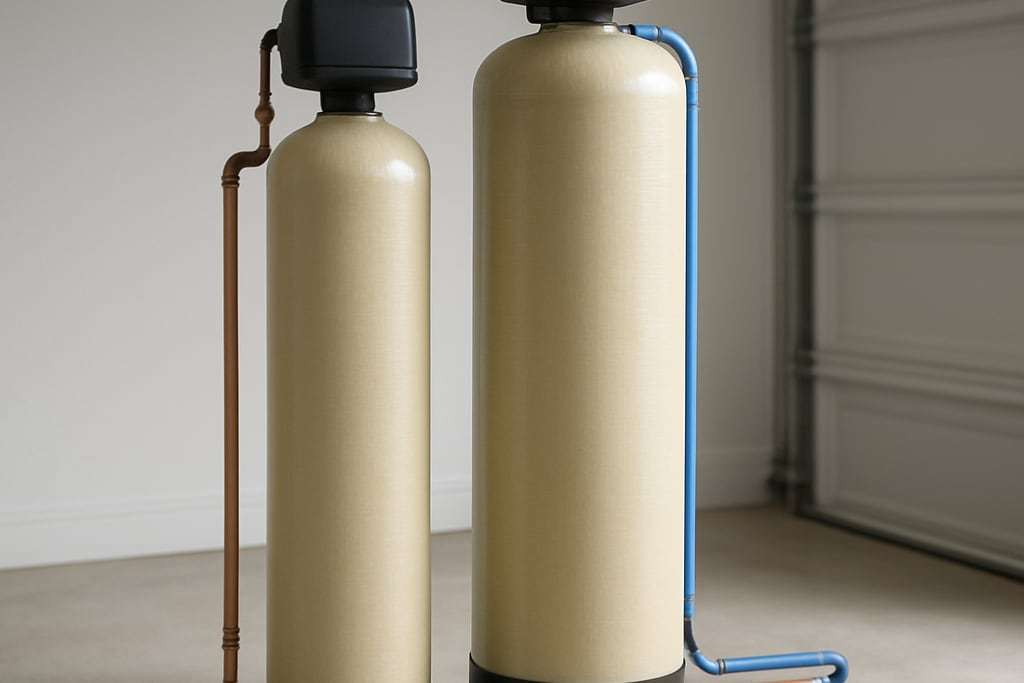
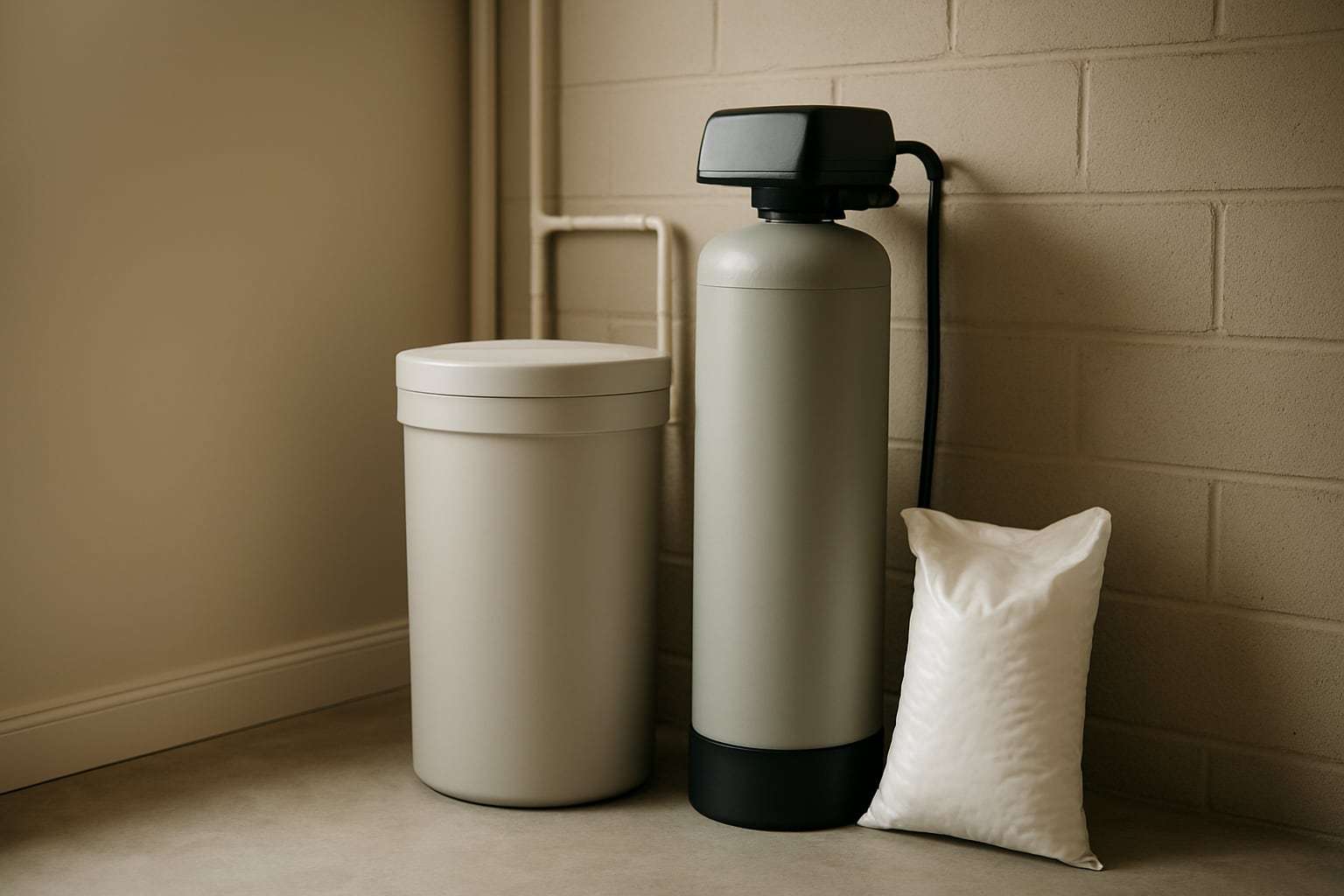
A softener is an ion-exchange tank. Water passes through resin beads loaded with sodium. Calcium and magnesium stick to the beads, and sodium goes into the water in their place. When the resin is full, a brine of salt flushes it clean and sends the hardness to the drain. The University of Nebraska describes this cycle in NebGuide G1274 and G1491, and the brine and flush step takes about one to two hours, using about 50 gallons of water each time, per Penn State Extension and NebGuide G1491.
The softener’s standard is NSF/ANSI 44, the standard for cation-exchange softeners that measures hardness removal. The softener size calculator shows how grain capacity, household size and hardness fit together, and the hardness converter explains how to read the hardness number on a test.
Hardness is mainly a problem of scale and soap rather than a health limit. The problems are the ones people notice: white scale in kettles and fixtures, spots on glass, and soap that does not lather well. NDSU Extension says consumers typically notice these above about 6 to 7 grains per gallon.
What a whole house filter does
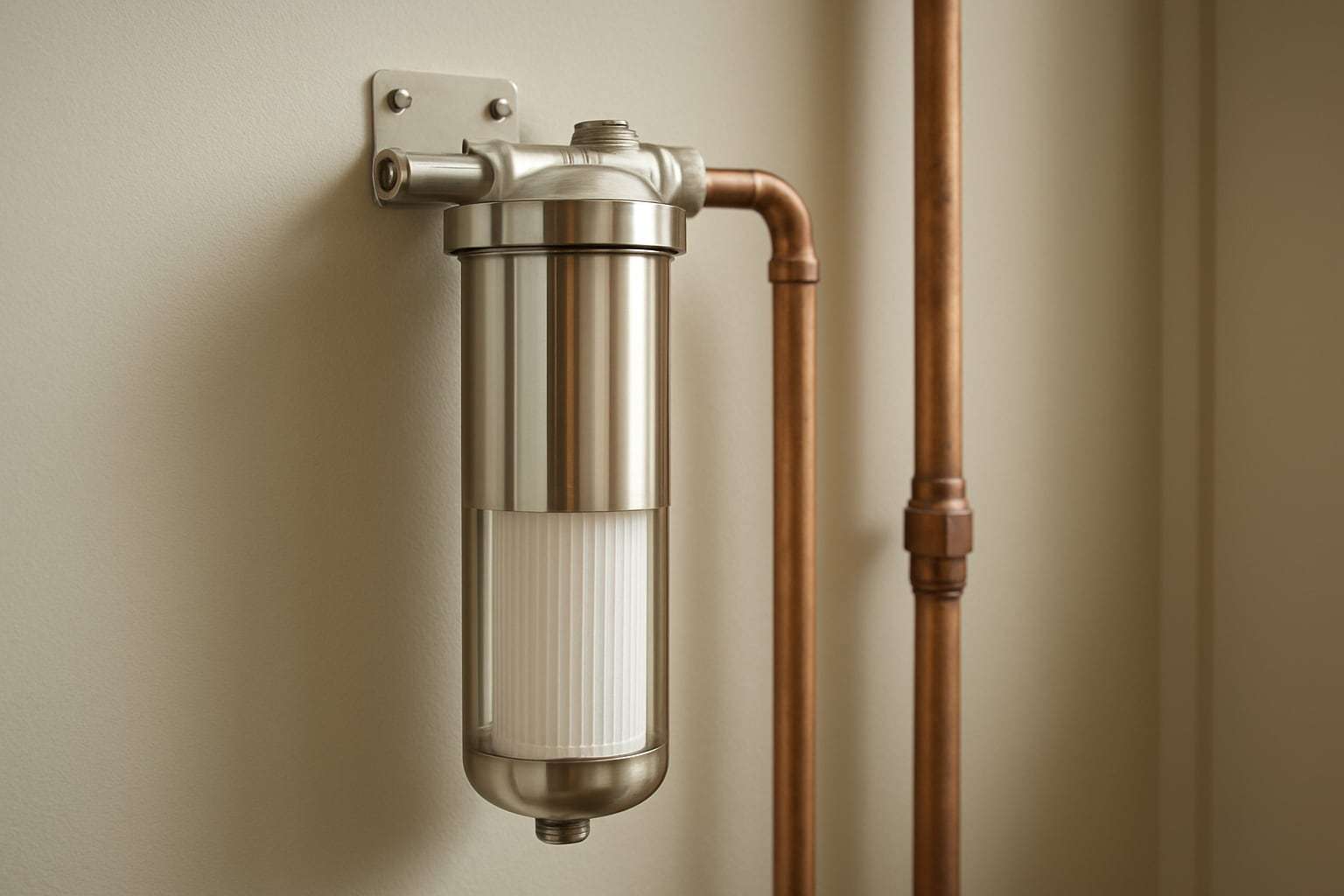
A whole house filter is a set of media, and the media decides the job:
- Sediment cartridges trap particles. Many brands use 5-micron cartridges. Penn State and the University of Georgia both recommend a sediment filter at the point of entry, which protects any carbon behind it.
- Activated carbon removes residual chlorine, taste and odor, many organic compounds such as volatile organic chemicals and some pesticides, and some trihalomethanes. The University of Georgia also lists radon and, in solid-block units, Giardia and Cryptosporidium cysts.
- Catalytic carbon is made to break down chloramine, which plain carbon handles poorly. Ask your utility which disinfectant it uses; the annual water quality report says.
- KDF is a copper-zinc alloy that brands describe as reducing chlorine and heavy metals. These are brand claims, not independent test results.
- Iron and manganese media are a separate category. Some products combine them with carbon, such as the iSpring WGB32BM, which lists iron up to 3.0 ppm.
Carbon does not remove bacteria, nitrate, fluoride, chloride or hardness, according to the University of Georgia. Carbon media can also grow bacteria, so the bulletin says to use carbon only on water that is already microbiologically safe.
Side by side
| Problem | Water softener | Whole house filter |
|---|---|---|
| Hardness (scale, spots, soap) | Removes calcium and magnesium | Does not remove hardness |
| Chlorine or chloramine taste | Not the job it is sold for | Carbon handles chlorine and taste; catalytic carbon for chloramine |
| Sediment and grit | Needs a sediment filter ahead of it; turbid water can clog resin | Sediment cartridge catches particles |
| Dissolved iron | Handles it only up to the unit’s rated limit | Iron media only in a product rated for iron |
| Red (oxidized) iron | Clogs resin; filter it out first | Filter removes particles; oxidizing media for iron |
| Bacteria | Does not treat bacteria | Carbon does not remove bacteria; use UV or another tested method |
| Lead, nitrate, arsenic | Not its job | Only a model certified for that claim, such as NSF/ANSI 53 |
| PFAS | A standard softener is not a PFAS technology | Only a model certified for PFOA and PFOS reduction |
Any claim you see in a product listing should be matched to a standard and a model. A component certification, such as a tank tested to NSF/ANSI 61, does not certify the whole system for a contaminant.
When you need one, the other, or both
You probably need a softener if your main complaint is scale, spots or soap that will not lather, and your water tests hard, around 7 grains per gallon or more where people notice problems.
You probably need a filter if the water tastes or smells of chlorine, looks cloudy or gritty, or your utility uses chloramine and you want a carbon stage that is rated for it.
You probably need both if the water is hard and also has taste, chlorine or sediment. Install the filter ahead of the softener. The combo guide covers install order and costs.
Neither is enough if the water may carry bacteria, nitrate or lead. Test first. The well water testing guide explains what to ask a lab for. The University of Georgia says carbon is not a bacteria treatment.
A salt-free conditioner is a different kind of device. The Nebraska Extension article on salt-free alternatives says these technologies generally do not remove most hardness minerals; they change how the minerals behave. If you want the hardness number gone, a conditioner is the wrong tool. Our conditioner vs softener comparison goes into more detail.
Cost comparison
Softener purchase prices run from about $500 to $1,700 for a single-tank unit, with installation labor from $150 to $1,000, according to This Old House. Bob Vila puts a salt-based softener at $500 to $3,000 installed. Whole house carbon systems from the brands listed on this site run from $535.99 for the iSpring WGB32BM to $1,998 for the Aquasana Rhino.
Running costs differ too. A softener needs salt, typically $5 to $10 per 40-pound bag of sodium chloride (roughly $50 to $150 a year for a typical household, as an estimate), and tank service of about $100 to $200 a year if you pay a pro. A filter needs cartridge changes, usually every 6 to 12 months, and sediment pre-filters are the most frequent item. The softener cost guide and the whole house filter cost guide show the full ten-year picture.
Common mistakes
- Buying a carbon filter for hard water. You will still get scale, because carbon does not remove hardness.
- Expecting a softener to fix taste. A softener is not sold as a taste fix.
- Skipping the test. Hardness, chlorine, iron and bacteria each point to a different system.
- Putting a softener on red iron. Oxidized iron clogs resin, so it needs filtering first.
- Trusting a general claim. “Removes contaminants” needs a standard, a claim and a model number.
How to decide in one hour
- Get a hardness number in grains per gallon. Your utility report or a lab test gives it; a home kit is a rough check.
- Ask the utility, or read the annual report, to find out whether the water uses chlorine or chloramine.
- If you use a well, get a state-certified lab test for bacteria, nitrate, iron, manganese, pH and sulfur before buying anything.
- Match each result to a part in the list above. Only buy the part for a problem you have measured.
Frequently asked questions
Can a whole house filter soften water?
No. Activated carbon does not remove hardness, which is the calcium and magnesium in water. The University of Georgia bulletin lists hardness among the things carbon does not remove. Softening needs an ion-exchange softener, or a different treatment that the maker names, and a salt-free conditioner is not a softener.
If my water tastes of chlorine, will a softener fix it?
A softener is sold to remove hardness, not chlorine taste. Taste and odor are the problems activated carbon is used for, according to the University of Georgia. Test the water and talk to the filter maker about carbon for chlorine or chloramine.
Does a water softener remove PFAS?
A standard softener is a cation exchanger that swaps sodium for calcium and magnesium. EPA's treatment fact sheet names anion exchange, not that softener process, as a PFAS technology, so a standard softener should not be counted on for PFAS. Look for a PFOA and PFOS reduction claim certified under NSF/ANSI 53 or 58 for the exact model.
Which should go first, the filter or the softener?
Usually the filter, for particles and any oxidized iron, because sediment and turbid water can clog softener resin. Penn State Extension says oxidized iron clogs resin. The installer should design the order around your water test, and local code and a licensed plumber decide the connections.
Does softened water add sodium to my drinking water?
Softening adds sodium: about 8 mg/L for each grain per gallon of hardness removed. People on a sodium-restricted diet should ask a doctor before drinking softened water. Many homes leave the kitchen cold tap unsoftened for drinking and cooking, as NDSU Extension suggests.