The short answer
To convert water hardness, divide ppm (mg/L) by 17.1 to get grains per gallon, or multiply grains per gallon by 17.1 to get ppm. For example, 257 ppm is about 15 grains per gallon, which is very hard on the scale used by Nebraska and Penn State Extension. Use the converter above, then get a real number from your utility report or a lab test before you size or buy anything.
Try it with your numbers
Water hardness is reported in two common units, parts per million (ppm, the same as mg/L for water) and grains per gallon (gpg). A softener is sized in grains, a lab report may give milligrams, and a utility report may use either. This converter moves the number between them, so you can read any report and compare it with a softener’s rating.
The conversion
- ppm to gpg: divide by 17.1. For example, 171 ppm is 10 gpg, and 60 ppm is about 3.5 gpg.
- gpg to ppm: multiply by 17.1. For example, 15 gpg is about 257 ppm.
The number 17.1 comes from the weight of a grain (64.8 milligrams) divided by the volume of a US gallon (3.785 liters), which gives about 17.1. NDSU and Penn State Extension round it to about 17. This page and the converter both use 17.1, so the two match exactly.
Hardness bands
This site uses one scale everywhere: the five-band table below, from the US Department of the Interior and the Water Quality Association, as published by Nebraska and Penn State Extension.
| Class | Grains per gallon | ppm (mg/L) |
|---|---|---|
| Soft | under 1.0 | under 17.1 |
| Slightly hard | 1.0 to 3.5 | 17.1 to 60 |
| Moderately hard | 3.5 to 7.0 | 60 to 120 |
| Hard | 7.0 to 10.5 | 120 to 180 |
| Very hard | over 10.5 | over 180 |
Some seller charts use other cutoffs, such as calling 7 to 11 grains “hard”. Use the cutoffs in the table when you compare numbers.
What hardness does to a home
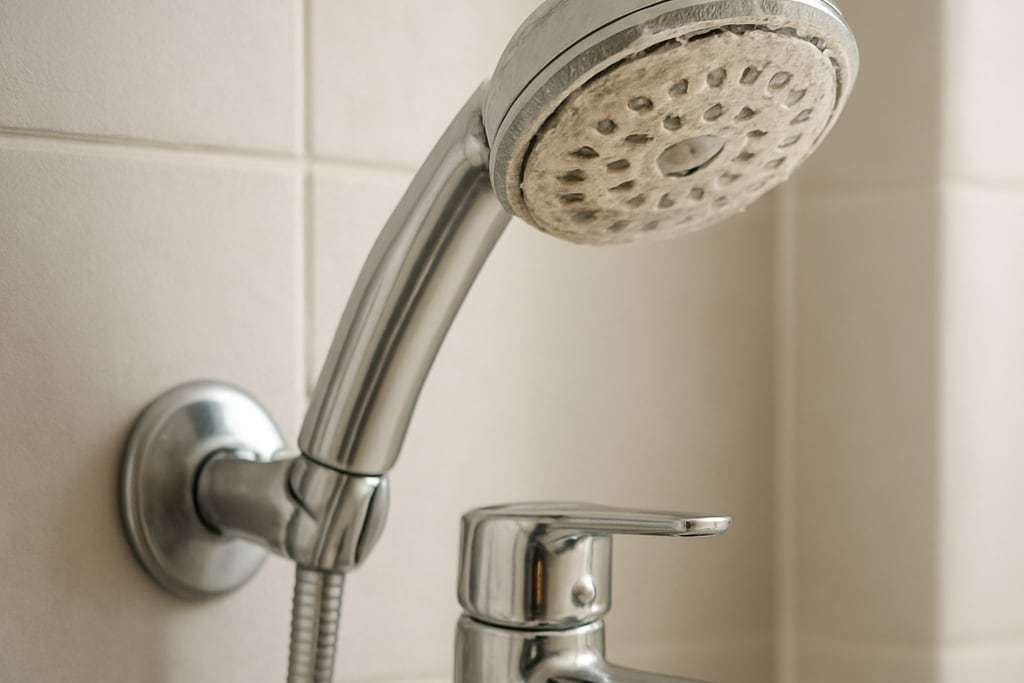
Hardness is mostly dissolved calcium and magnesium, reported as calcium carbonate. NDSU Extension says consumers typically notice problems above about 6 to 7 grains per gallon, which is roughly 100 to 120 ppm. Those problems are scale in kettles and fixtures, spots on glass, and soap that does not lather well.
How to find your hardness
- Ask the utility. Check the annual water quality report or call the utility for its hardness figure. Utility numbers reflect the public supply, not water after your own equipment.
- Use a home test strip or kit for a quick check. It gives a rough number. Use it to decide whether a lab test is worth paying for, not to size a softener.
- Use a lab for a well. EPA advises a state-certified lab for private well testing. Ask for hardness as calcium carbonate, in mg/L or grains per gallon, and ask for iron (dissolved and total) and manganese at the same time, because they change the answer.
If a report gives hardness as total hardness as calcium carbonate, that is the number to convert. Most water tests report it that way.
Using the number
Once you have grains per gallon, use it in the water softener size calculator. If you want a rough idea of typical hardness where you live first, see our water hardness by city data page. The calculator adds about 5 grains per gallon for each ppm of iron, so keep iron in the same calculation.
A salt-free conditioner does not change the hardness reading. The Nebraska Extension article on salt-free alternatives says these devices generally do not remove most hardness minerals; they change how the minerals behave. Test again after any device to see whether the number moved. Our conditioner vs softener comparison explains the difference. Once you know you are in the hard or very hard bands, the best water softener guide starts with a 48,000-grain Fleck at $1,995.
A carbon filter does not reduce hardness either, according to the University of Georgia. A tap test after a carbon filter should show the same hardness as before it.
Common mistakes
- Mixing units. A softener sized on ppm will be far too small. Convert every number to grains per gallon first.
- Not checking the unit on your report. Look for ppm, mg/L or gpg before you convert anything.
- Reading “as calcium carbonate” as a different unit. It describes how hardness is reported, not a separate measurement.
- Treating one test as the full answer. A single strip reading is rough. Repeat the test or send a sample to a lab before a purchase.
- Forgetting iron. Iron adds to the sizing load under the common installer method, so a hardness number alone can understate what the softener must handle.
For a full view of the options once you know the number, read our hard water treatment guide.
Frequently asked questions
How many ppm is one grain per gallon?
About 17.1 parts per million, or 17.1 mg/L. The number comes from a grain weighing 64.8 milligrams and a US gallon of 3.785 liters. Some extension sources round it to 17; this page uses 17.1 throughout.
Is 10 grains per gallon hard water?
Yes. Ten grains per gallon is about 171 ppm, which falls in the hard band of the five-band scale used by Nebraska and Penn State Extension (7.0 to 10.5 grains per gallon, or 120 to 180 ppm).
Is ppm the same as mg/L?
For water, yes. Hardness is usually reported as milligrams per liter of calcium carbonate, which is the same as parts per million. Look for the words as calcium carbonate on a lab report.
Does high hardness make water unsafe to drink?
Extension guides describe hardness through the problems people notice: scale, spots and soap that does not lather well. They do not present it as a health limit. Other contaminants, such as nitrate or bacteria, need their own tests.