The short answer
Manganese leaves brownish-black stains on laundry, porcelain and dishes, and in a few shallow wells it tints the water black. Get a lab test for manganese, iron, pH and hydrogen sulfide first, then match the filter to the number. For light manganese (up to 1 ppm) the iSpring WGB32BM is $535.99. For more, start with the SoftPro AIO Iron Master from $1,517, which SoftPro rates for manganese up to 7 ppm.
We earn a commission when you buy through some links on this site, at no extra cost to you. It never changes what we recommend.
Our picks
SoftPro AIO Iron Master (air-injection iron filter, Katalox media)
Air-injection iron filter
Air-injection filter rated by SoftPro for manganese up to 7 ppm and iron up to 30 ppm, with no chemicals, salt or permanganate.
- Sizes and minimum well flow1.0 cu ft needs at least 5 GPM; 1.5 cu ft at least 7 GPM; 2.0 cu ft at least 10 GPM (for backwash)
- Media and methodKatalox Light with air-injection oxidation; no chemicals, salt or permanganate
- Rated removalIron up to 30 ppm (larger units or a dual setup may be needed at the high end); manganese up to 7 ppm; hydrogen sulfide
Listed price$1,517 (1.0 cu ft); $1,757 (1.5 cu ft); $1,897 (2.0 cu ft)
Check price at SoftProSpecs & trade-offs
From $1,517; it needs 5, 7 or 10 GPM of well flow to backwash.
- Rated removal
- Iron up to 30 ppm (larger units or a dual setup may be needed at the high end); manganese up to 7 ppm; hydrogen sulfide
- Sizes and minimum well flow
- 1.0 cu ft needs at least 5 GPM; 1.5 cu ft at least 7 GPM; 2.0 cu ft at least 10 GPM (for backwash)
- Media and method
- Katalox Light with air-injection oxidation; no chemicals, salt or permanganate
- Other
- Raises low pH; filters sediment down to 3 microns; 1 in programmable valve with automatic backwash
- Placement
- Installs ahead of the softener so iron does not reach the resin
- Higher published iron rating (30 ppm) than SpringWell's WS filter (7 ppm), and a lower entry price ($1,517 vs starting at $2,100)
- No chemicals to refill
- Needs enough well flow to backwash (5, 7 or 10 GPM depending on size)
- The 30 ppm figure is SoftPro's own rating; no independent certification is shown
- Does not soften, so hard water still needs a softener after it
Fleck 2510 iron filter (1.5 cu ft Katalox Light) + Fleck 5600SXT 48,000-grain softener package
Iron filter and salt-based softener package
Fleck 2510 air-injection filter rated for manganese up to 15 ppm and iron up to 30 ppm, plus a 48,000-grain softener, for $3,995.
- Media lifeKatalox Light about 6 to 8 years before the tank is re-bedded
- CertificationNSF/ANSI 61 certified components
- Sized for2 to 4 people, up to 3 bathrooms, up to 10 GPM whole-house flow
Listed price$3,995
Check price at Mid Atlantic Water (Fleck valves)Specs & trade-offs
The ratings are the seller's own.
- Iron filter
- Fleck 2510 AiQ air-injection valve; 1.5 cu ft Katalox Light; 10 in x 54 in tank; 10 GPM service, 5 GPM backwash
- Rated removal (iron filter)
- Iron up to 30 ppm; manganese up to 15 ppm; hydrogen sulfide up to 10 ppm
- Softener
- Fleck 5600SXT; 48,000 grains; 1.5 cu ft of 10% crosslink resin; 10 in x 54 in tank; up to 12 GPM service
- Sized for
- 2 to 4 people, up to 3 bathrooms, up to 10 GPM whole-house flow
- Media life
- Katalox Light about 6 to 8 years before the tank is re-bedded
- Warranty
- 5 years on each Fleck valve; 10 years on each mineral tank
- Certification
- NSF/ANSI 61 certified components
- pH note
- Iron removal works best near pH 8; a lower-pH well may need an acid neutralizer added
- Iron filter and softener sold as one correctly ordered system (iron filter first, softener second), with a published 30 ppm iron rating
- No salt, chemicals or cartridges on the iron filter side; free shipping and a free phone consultation on sizing
- Costs about $2,000 more than the softener alone
- Two systems to install: two outlets, two drains, and a plumber is recommended
- The ratings are the seller's own; only the components carry a certification (NSF/ANSI 61, which covers materials)
WGB32BM (sediment, carbon and iron/manganese catalytic media)
Whole-house filter (sediment, carbon, iron/manganese)
Manganese up to 1.0 ppm and iron up to 3.0 ppm, plus sediment and carbon stages, for $535.99.
- CapacityStages 1-2: 100,000 gallons; stage 3: 50,000 gallons at 3.0 ppm iron
- Peak flow15 GPM
- Stages5-micron polypropylene sediment; coconut shell carbon block; iron/manganese catalytic media (no chemicals)
Specs & trade-offs
Warranty is 1 year.
- Peak flow
- 15 GPM
- Stages
- 5-micron polypropylene sediment; coconut shell carbon block; iron/manganese catalytic media (no chemicals)
- Iron and manganese rating
- Iron up to 3.0 ppm; manganese up to 1.0 ppm
- Capacity
- Stages 1-2: 100,000 gallons; stage 3: 50,000 gallons at 3.0 ppm iron
- Replacement
- Every 6-12 months
- Warranty
- 1 year; lifetime tech support after registering
- Treats iron and manganese without chemicals (catalytic media)
- Sediment and carbon stages in the same unit
- Does not reduce TDS, arsenic, nitrates, copper or lead
- No NSF/ANSI certification is stated for the complete system
- 1-year warranty
| Model | Best for | Type | Listed price |
|---|---|---|---|
| SoftPro AIO Iron Master (air-injection iron filter, Katalox media) | Best for higher manganese | Air-injection iron filter | $1,517 (1.0 cu ft); $1,757 (1.5 cu ft); $1,897 (2.0 cu ft) |
| Fleck 2510 iron filter (1.5 cu ft Katalox Light) + Fleck 5600SXT 48,000-grain softener package | Highest published rating, with a softener | Iron filter and salt-based softener package | $3,995 |
| WGB32BM (sediment, carbon and iron/manganese catalytic media) | Cheapest, for light manganese | Whole-house filter (sediment, carbon, iron/manganese) | $535.99 |
We have not tested these products. The guidance below comes from published sources, and the product ratings come from each maker’s own page.
What manganese looks like in your home
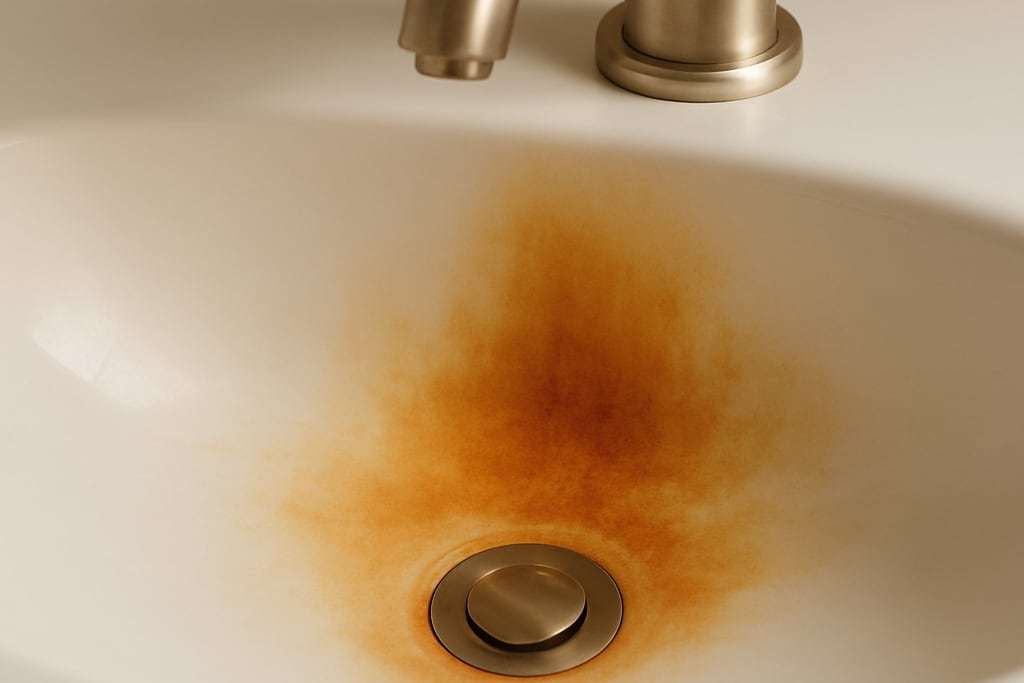
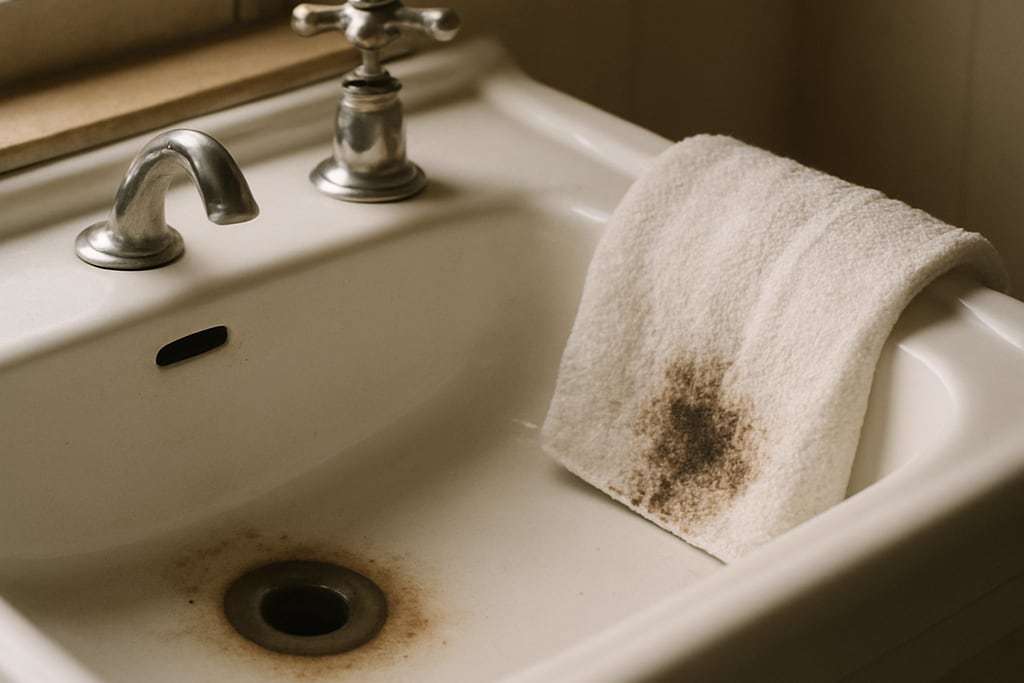
Manganese stains are brownish-black. Nebraska Extension says it marks laundry, porcelain, dishes, utensils and glassware, and that soap and detergent do not lift the stains. Chlorine bleach and alkaline laundry builders can make them worse. Manganese can also react with the tannins in coffee, tea and some drinks and leave a black sludge. In a few shallow wells the manganese is colloidal and gives the water itself a black tint.
Iron stains look different: rust-colored, orange or red-brown. Many wells carry both metals, so a sink with orange and black marks is common. A black or red slime layer in a toilet tank is a separate sign. It can point to iron or manganese bacteria, which Nebraska describes as a nuisance rather than a health hazard, and it is worth asking the lab to test for them.
The test and the numbers that matter
Stains tell you manganese is present, not how much. A lab test tells you how much. Use a lab that follows EPA-approved methods for iron and manganese, and ask for manganese, dissolved and total iron, pH and hydrogen sulfide. The well water testing guide explains how often to test and what to add.
Here are the reference numbers. Milligrams per liter (mg/L) and parts per million (ppm) are the same thing for water.
| Manganese level | What it means |
|---|---|
| 0.05 mg/L | EPA secondary guideline for staining and taste. It is recommended, not enforceable, and EPA’s enforceable rules cover public systems, not private wells |
| 0.3 mg/L | EPA lifetime health advisory. Nebraska Extension says not to use water above this level to mix rice or soy infant formula |
| 1.0 mg/L | Nebraska Extension says water above this level should not be used for drinking; use filtered or bottled water |
Those health lines are why a high result deserves a quick follow-up with your health department or a water professional. Below the 0.05 mg/L guideline you are mostly dealing with stains.
How manganese differs from iron
Iron and manganese show up together and cause similar stain, taste and appearance problems, but they behave differently in treatment. The iron in well water guide covers iron on its own.
- Color. Dissolved iron turns from white to yellow to red-brown as it meets air. Manganese stays dissolved longer and forms black or brownish-black particles.
- Oxidizing it. Aeration needs more time and oxygen for manganese than for iron.
- pH. Chlorine works best on iron at pH 6.5 to 7.5, but it needs a pH of 9.5 or higher to fully oxidize manganese, so Nebraska does not recommend chlorine for very high manganese. Potassium permanganate works better on manganese above pH 7.5.
- Phosphate treatment. Polyphosphate can sequester light iron, but it does not remove manganese.
- Health. Nebraska says iron is not considered a health hazard at typical levels, while manganese can be at elevated levels.
What removes it, and at what level
The approach depends on how much dissolved and particle manganese is in the water, and on pH. Most methods work best near pH 7. Nebraska Extension gives these levels for iron and manganese together:
| Situation | Usual approach |
|---|---|
| Dissolved manganese below about 0.5 mg/L | Ion-exchange softener with a rated manganese limit |
| Combined iron and manganese up to about 1 mg/L | Oxidizing filter, such as manganese greensand or coated media |
| Combined iron and manganese about 5 to 10 mg/L | Aeration, then filtration |
| Above about 10 mg/L | Chemical oxidation with chlorine or permanganate, then filtration |
| Manganese in both dissolved and particle form | Multistage: oxidize and filter, carbon to remove leftover chlorine, then soften |
Aeration is not recommended where iron or manganese bacteria are present, and bacteria call for their own plan, usually with a contractor.
For drinking water only, Nebraska lists reverse osmosis, distillation and carbon filtration as point-of-use options for dissolved manganese. Some faucet and pitcher filters are made for it, but Nebraska says their life can be much shorter above 0.2 mg/L. If the whole house has the problem, treat the main line first. See the well water filter guide for how the other pieces fit.
If you plan to add a UV unit for bacteria, manganese matters there too. Vendor guidance asks for manganese below 0.05 ppm ahead of UV, because it absorbs UV light and can scale the lamp sleeve. The UV guide has the details.
Products that publish a manganese rating
Four visible products on this site publish a manganese figure. All the ratings are the makers’ own. None names an independent test report for manganese, and the extension ceiling for oxidizing filters is lower than the makers’ numbers, so ask for the test data behind a rating before you assume your water fits.
- SoftPro AIO Iron Master, from $1,517. An air-injection filter with Katalox Light media. SoftPro rates it for manganese up to 7 ppm and iron up to 30 ppm, with hydrogen sulfide removal too. The 1.0 cubic foot size needs at least 5 GPM from the well to backwash; the 1.5 and 2.0 cubic foot sizes ($1,757 and $1,897) need 7 and 10 GPM. It does not soften, so hard water still needs a softener after it.
- Fleck 2510 filter and 48,000-grain softener package, $3,995. From Mid Atlantic Water. The air-injection iron filter is rated for manganese up to 15 ppm, iron up to 30 ppm and hydrogen sulfide up to 10 ppm, and the seller says it works best near pH 8, so a low-pH well may need an acid neutralizer. It costs about $2,000 more than the softener alone and needs two outlets and two drains.
- SpringWell WS series, from $2,100. Rated for manganese up to 1 ppm, iron up to 7 ppm and hydrogen sulfide up to 8 ppm, with a nightly backwash. A $134.25 water test is required.
- iSpring WGB32BM, $535.99. A three-stage filter with sediment, carbon and catalytic media, rated for manganese up to 1.0 ppm and iron up to 3.0 ppm. It suits light levels and a modest budget. Its cartridges need replacing every 6 to 12 months. The iron filter guide compares these filters in more detail.
Two products that look related do not publish a manganese figure. The SoftPro Elite HE softener lists clear-water iron up to 3 ppm only, and the Fleck 5600SXT softeners list an iron limit of about 1 ppm and no manganese number. If you are shopping for a softener on a well with manganese, ask the seller for the manganese limit in writing, and compare it with your lab result.
Questions to ask the seller
- What manganese level is the product rated for, and at what pH?
- What flow does it need to backwash, and how much water does each backwash use?
- Does it need potassium permanganate or any chemical refill?
- How long does the media last, and what does replacement cost?
- Is the rating backed by an independent test, or is it the company’s own figure?
- What does the warranty cover if the water test shows something different from what I told you?
Who should skip these picks
- Anyone above the rating. If your lab manganese is higher than a filter’s stated limit, that filter will not hold up.
- Anyone with a rotten-egg smell or black slime. Hydrogen sulfide and bacteria change the plan. See the sulfur smell guide.
- Anyone who only worries about drinking water. A point-of-use unit at the kitchen tap may cover that, but it will not stop black stains in the laundry.
- Anyone who has not tested. The right filter depends on pH, iron and the form of manganese, not on the color of the stain.
Buying mistakes to avoid
- Buying before the lab result. A stain tells you the problem exists, not the level or the pH.
- Treating manganese like iron. A setup tuned for iron at pH 7 may leave manganese behind.
- Trusting the highest number on a page. Choose a filter with room below its rating for your measured level.
- Using bleach on the stains. Nebraska says bleach can make manganese stains worse.
- Forgetting the softener. Iron and manganese filters do not soften. Hard water on a well often needs both, as the softener and filter combo guide explains.
Frequently asked questions
What causes black stains in a sink, toilet or washing machine?
Manganese is a common cause. Nebraska Extension says it leaves a brownish-black stain on laundry, porcelain, dishes, utensils and glassware, and that soap and detergent do not remove it. Chlorine bleach or alkaline laundry builders can make the stains worse. A black or red slime layer, for example in a toilet tank, can also point to iron or manganese bacteria, which is worth a separate test.
Is manganese in well water harmful?
At the EPA secondary level of 0.05 mg/L, manganese is mainly a stain and taste problem. Nebraska Extension adds health guidance for higher levels: do not use water above 0.3 mg/L to mix rice or soy infant formula, and do not use water above 1.0 mg/L for drinking. That is why a lab number matters more than the color of the stains.
Can a water softener remove manganese?
Sometimes. Nebraska Extension says an ion-exchange softener works on dissolved manganese below about 0.5 mg/L, and that potassium chloride may work better than sodium chloride for it. Above that, or when manganese is already in particle form, an oxidizing filter or aeration is the usual step. Check the softener's own iron and manganese limits, because many list an iron figure and no manganese figure.
Does reverse osmosis remove manganese?
Nebraska Extension lists reverse osmosis, distillation and carbon filtration as point-of-use options for dissolved manganese. Manganese also fouls RO membranes, so a well with a high level is better treated at the main line first, with an RO unit at the kitchen tap as the drinking-water step.
Do I need to treat iron and manganese separately?
Often one filter handles both, but they need different conditions. Chlorine oxidizes iron well at pH 6.5 to 7.5 and needs a pH of 9.5 or higher to fully oxidize manganese, according to Nebraska Extension. Read both numbers on your lab report, and check that the filter's rating names manganese, not only iron.
Sources
- University of Nebraska Extension: NebGuide G1714, iron, manganese and sulfur
- EPA: Secondary drinking water standards (nuisance chemicals)
- EPA: Protect your home's water (private wells)
- SoftPro: AIO Iron Master iron filter
- SpringWell: Whole-house iron filter (WS series)
- iSpring: Whole-house sediment, carbon and iron/manganese filter
- Mid Atlantic Water: Fleck 2510 iron filter and 48,000-grain softener package